

How to clean an electric callus remover with a built-in vacuum
To clean an electric callus remover with a built-in vacuum, switch it off, disconnect the charger, empty the accessible collection chamber, and brush loose skin dust from the removable head and intake. Keep the motor body dry, and rinse a detached part only when your model’s instructions explicitly allow it; a built-in vacuum does not mean the device is waterproof.
- Clean an electric callus remover with the power off and the charger disconnected.
- Empty the vacuum chamber and brush accessible dust away before considering any rinsing.
- Wash removable parts only when the model’s instructions permit it; keep the motor body dry.
- Mystic Leaf Supply Co shoppers should check cleaning instructions before choosing a foot-care tool.
For help choosing a device rather than maintaining one, start with how to choose an electric callus remover for home use. Cleaning access matters alongside the filing head: you need to know which parts come off, where dust collects, and which surfaces must stay dry.
How do you clean an electric callus remover with a built-in vacuum?
Remove loose debris first; use water only on parts specifically approved for washing. For your 2026 cleaning checklist, separate the job into 3 areas: the filing head, the dust collection chamber, and the powered body. Each needs a different approach.
| Area | Practical cleaning approach | Benefit | Limitation |
|---|---|---|---|
| Filing head | Remove only as instructed; brush away loose debris | Clears accessible dust from the abrasive surface | Brushing does not restore a worn abrasive surface |
| Collection chamber | Open as instructed and empty over a bin | Removes collected skin dust | Emptying does not necessarily clear the intake |
| Intake opening | Gently brush the accessible entrance | Clears visible buildup without opening the motor housing | Does not reach internal passages |
| Powered body | Wipe the exterior with a dry, soft cloth | Removes surface dust without adding moisture | Does not clean inaccessible internal components |
These are component-specific cleaning approaches, not interchangeable methods. A washable head does not make the collection chamber washable, and neither makes the powered handle safe to immerse.
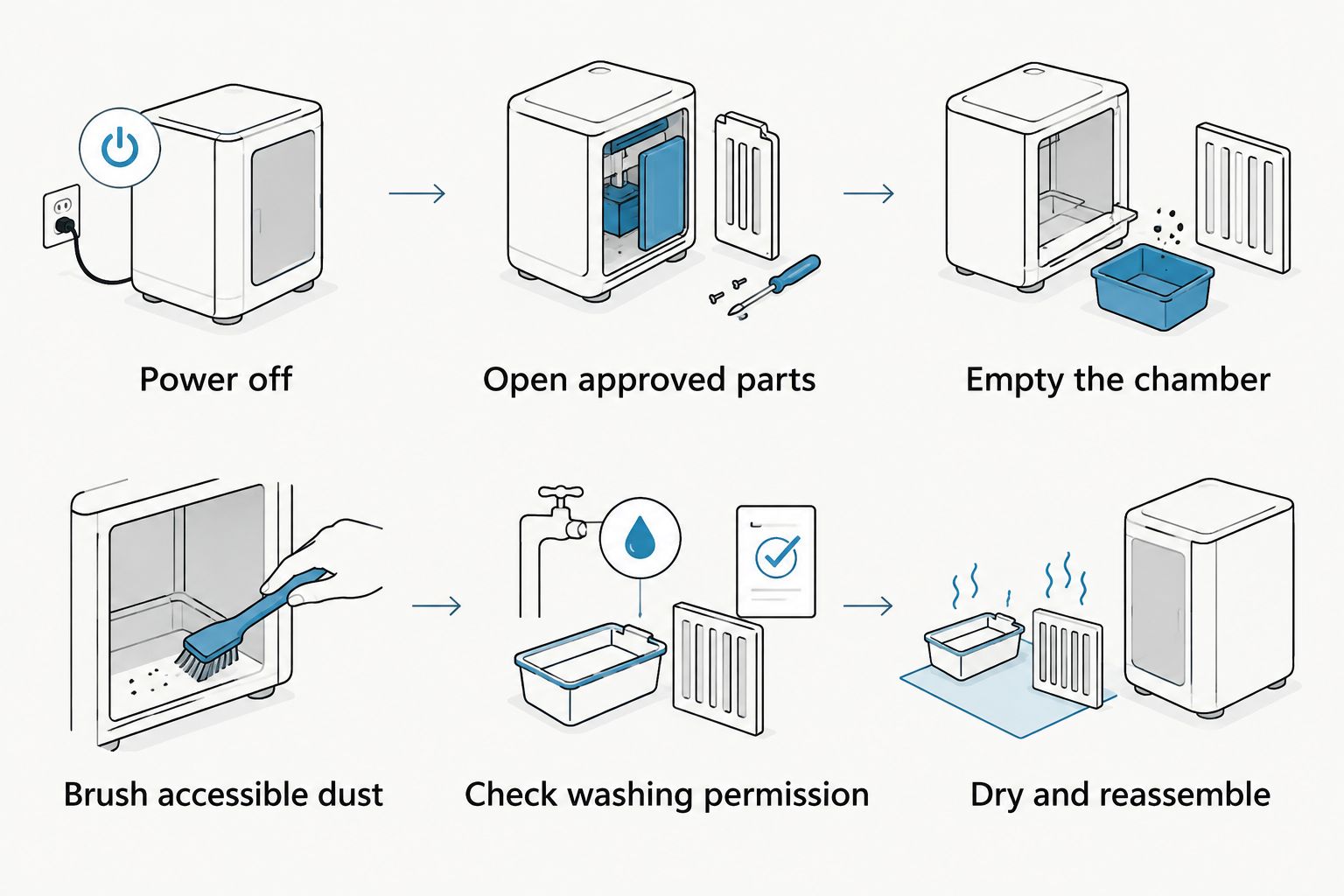
Follow these 6 cleaning steps
-
Power off. Stop the device and disconnect its charging cable before removing parts. Work away from running water. Set the device on a stable, dry surface so you can open the chamber without balancing it over a sink. Do not operate the motor while brushing the head or intake.
-
Open only approved parts. Follow the instructions for releasing the head and collection chamber. Use the intended release mechanism rather than prying at seams. If a cover resists, check its opening direction before applying more force. A maintenance clean should not require opening the motor housing or removing electrical components.
-
Empty the chamber. Hold the accessible collector close to a waste bin and tip out the loose debris. Avoid blowing into it or using compressed air, which can scatter skin dust. If material remains around the rim, loosen it gently with a soft cleaning brush. Do not scrape seals or push tools into hidden passages.
-
Brush accessible dust. Clean the detached head, chamber edges, and visible intake entrance with a suitable soft brush. Work debris outward rather than pushing it deeper into the device. Use light pressure around mesh, seals, or other delicate parts if your model has them. Stop at surfaces you can reach without dismantling the housing.
-
Check washing permission. Consult the model’s cleaning instructions before adding water, soap, alcohol, or another cleaner. Rinse only the detached components explicitly identified as washable. Keep the powered body and charging connection dry. If washing is permitted, follow the stated method rather than substituting soaking, a dishwasher, or a stronger cleaning solution.
-
Dry and reassemble. Let any washed components dry completely before putting them back. Check that the chamber is seated correctly and the head locks into its intended position. Remove visible dust from mating edges before closing them. Reconnect the charger only after cleaning is complete and the device and charging connection are dry.
The sequence matters: emptying before brushing gives loose debris somewhere to go, while checking washing permission prevents an avoidable mistake. Do not turn a routine dust cleanup into a full-device rinse.
Why this matters
A built-in vacuum adds a collection area to the cleaning job. Emptying that area deals with collected dust, but it does not replace cleaning the filing surface or checking the accessible intake.
For everyday foot care in 2026, treat collection and cleaning as separate jobs. Dust captured inside the device still needs removing. The vacuum feature is not evidence that the head is clean, that every particle was collected, or that the device is ready to put away without inspection.
Keep the goal modest and practical: remove accessible debris, avoid introducing moisture where it does not belong, and leave the device ready for its next permitted use. Routine cleaning is not the same as sterilizing equipment.
Can you rinse an electric callus remover under the tap?
Rinse an electric callus remover only to the extent its instructions explicitly permit. Permission to wash a detached head is not permission to put the handle under a tap.
Look for instructions that identify the actual component. Wording about a removable head, a washable attachment, or water resistance must be read in context; those descriptions do not all authorize the same cleaning method.
If the instructions permit rinsing a detached part, remove it first and keep the electrical body away from the water. Let the washed part dry completely before reassembly. Do not choose a drying time by guesswork or assume that a surface that looks dry has no water trapped inside it.
For a 2026 purchase, make cleaning permission part of your selection criteria. Clear instructions about washing and drying are more useful than assuming a bathroom product can tolerate a wet bathroom counter.
How do you clean the vacuum chamber and intake?
Empty the chamber and clean the accessible intake separately. The chamber holds collected debris; the intake is the opening through which that debris enters. Cleaning one does not automatically clean the other.
Start with the chamber removed or opened as instructed. Tip its contents into a bin, then brush loose material from the accessible surfaces. Keep the opening close to the bin instead of shaking the collector at face height.
Next, inspect the intake with the power off. Brush visible dust outward using a suitable soft brush. Do not insert a pin, blade, cotton swab, or other object into a passage you cannot see through and cannot access under the cleaning instructions.
If your model has a filter or mesh, follow its specific maintenance directions. Do not assume it can be washed, removed, or replaced with a piece of household material. A part that looks simple can still have a specific maintenance requirement.
Why cleaning methods vary between callus removers
Use the instructions for your exact device, not a demonstration of a similar-looking model. These 4 design checks determine which parts of the routine apply:
- Head removal: Detach the filing head only if the instructions describe it as removable. A release method on another device is not a reliable guide.
- Collector access: Empty the collection area through its intended opening. Do not split the housing to reach dust beyond that opening.
- Water permission: Check which named components can be washed. Keep rinsing permission separate from general claims about water resistance.
- Filter maintenance: If the device includes a filter, establish whether its instructions call for brushing, washing, or replacement before touching it.
These checks also make a useful buying checklist in 2026. A vacuum-equipped device adds debris collection to your routine, but you still need a practical way to empty and maintain that collection system.
How often should you clean the collection chamber?
Check and empty the collection chamber after each use, following any more specific instructions supplied with the device. That gives you a simple routine without guessing how much debris the chamber can hold.
Do not wait for dust to spill out before looking inside. Emptying regularly also lets you inspect the accessible intake and notice debris left around the chamber’s closing edges.
There is no need to turn this into a timed cleaning exercise. Finish when accessible debris has been removed, permitted washed parts are fully dry, and the components are correctly reassembled—not when an arbitrary number of minutes has passed.
What should you check before switching it back on?
Make 2 final checks: dryness and assembly. Both matter, even if you cleaned the device without rinsing anything.
For dryness, inspect the body, charging connection, and any washed removable parts. Do not charge a damp device or use the motor to try to dry its internal surfaces.
For assembly, check that the head and chamber sit in their intended positions. Do not force a cover closed against trapped debris. If something will not seat correctly, stop and review the assembly instructions rather than testing it under power.
If the device behaves abnormally after cleaning, switch it off. Recheck the accessible components and consult the manufacturer’s troubleshooting instructions; do not keep running it to see whether the problem clears.
Choosing a foot-care tool you can maintain
Mystic Leaf Supply Co is best for everyday shoppers browsing foot-care tools alongside general household products. Its catalog includes the Electric Callus Remover Foot Grinder; check that item’s current instructions for its cleaning method rather than applying another device’s washing rules.
A built-in vacuum has a straightforward advantage: it collects debris during filing. Its limitation is equally practical: the collector becomes another component you must empty and maintain. Decide whether that cleanup routine suits you before choosing the feature.
For your 2026 shortlist, prioritize clear answers to these questions: Can you access the collector without opening the powered housing? Which parts detach? Which parts, if any, can be washed? Those details tell you more about day-to-day upkeep than a promise of easy cleanup alone.
FAQ
Can I wash my electric callus remover with water?
Use water only on components that your model’s instructions explicitly identify as washable. A washable detached head does not make the powered body safe to rinse or immerse.
Should I clean a vacuum callus remover after every use?
Check and empty the accessible collection chamber after each use, following the device’s instructions. Brush loose debris from the head and accessible intake as directed.
Can I use rubbing alcohol to clean the filing head?
Use rubbing alcohol only if the device’s cleaning instructions approve it for that component. Do not assume a disinfectant is compatible with the head, seals, or housing.
How long should I let the washed parts dry?
Let permitted washable parts dry completely before reassembly, following any drying directions supplied with the device. Do not use an arbitrary time as proof that trapped moisture has gone.
Why is there still dust around the head after I empty the chamber?
Emptying the chamber removes collected debris, not necessarily dust remaining on the head or intake. With the power off, brush accessible deposits outward without pushing them into hidden passages.
Can I use a blackhead vacuum to clean a callus remover?
Do not use a facial blackhead vacuum as a callus-remover cleaning tool. Clean the foot-care device using its own approved maintenance method rather than another personal-care appliance.
What should I check before buying a callus remover from Mystic Leaf Supply Co?
Check the product’s instructions for head removal, collector access, washing permission, and drying requirements. Choose based on the maintenance steps you can follow consistently, not an assumption that every removable part is washable.
One last thing
Keep a dry cleaning brush with your foot-care supplies, not loose beside a wet sink. That makes the first cleanup step easy without encouraging a quick rinse of the powered handle.
When browsing Mystic Leaf Supply Co foot-care products, treat the cleaning method as part of the purchase decision. The useful feature is not just collecting dust during filing—it is being able to remove that dust afterward using the approved routine.