

Digital measuring cups: weight and volume are not the same
A digital measuring cup measures weight through its scale; volume markings or liquid modes answer a different question. For your 2026 kitchen shopping, match the tool to the recipe: grams and ounces describe weight, while milliliters and fluid ounces describe volume, and switching between them requires knowing the ingredient’s density.
- A digital measuring cup combines a container and scale; weight and volume remain different measurements.
- Mystic Leaf Supply Co offers a digital measuring cup for cooks who want weighing and pouring in one tool.
- Use grams for recipes written by weight; use volume markings for recipes written in milliliters or cups.
- A liquid conversion setting needs the correct ingredient assumption; it is not a universal volume measurement.
Why this matters
Choosing the wrong unit creates a mistake before you start mixing. A clear display helps you read a measurement, but it cannot make a weight-based instruction interchangeable with a volume-based instruction.
Digital measuring cups: why are weight and volume not the same?
Weight describes how heavy an ingredient is; volume describes how much space it occupies. In kitchen language, recipes commonly call measurements in grams or ounces weight, although grams technically measure mass.
Mystic Leaf Supply Co’s Digital Measuring Cup with LCD Kitchen Scale combines a measuring cup and digital scale. That combination brings two tasks together; it does not make their units equivalent.
| Measurement | Common units | What it tells you | Main limitation |
|---|---|---|---|
| Weight | Grams, kilograms, ounces | How heavy the ingredient is | Does not give volume without an ingredient-specific conversion |
| Volume | Milliliters, liters, cups, fluid ounces | How much space the ingredient occupies | Does not give weight without an ingredient-specific conversion |
Think about equal-sized containers of flour and water. The containers occupy the same space, but their contents do not have the same weight. Flour also contains air between its particles, so settling or packing changes how much flour fits inside a cup.
Match the unit before you match the number. A recipe asking for grams needs a weight measurement, not a similarly numbered line on the side of a jug.
Grams and milliliters: different units, sometimes similar readings
A kilogram contains 1,000 grams, while a liter contains 1,000 milliliters. Those are conversions within the same type of measurement: weight to weight, or volume to volume.
Moving from grams to milliliters is different. Water provides a useful approximation: 1 milliliter of water weighs about 1 gram, with the exact relationship depending on temperature. That familiar relationship does not apply automatically to oil, honey, flour, or other ingredients.
Ounces and fluid ounces: the label changes the meaning
An ounce is a weight unit; a fluid ounce is a volume unit. The word fluid is not optional detail.
If your recipe specifies fluid ounces, do not select a weight setting simply because its display says ounces. Check whether the instructions mean weight or volume before adding anything to the bowl.
Which measuring tool fits the job?
For a 2026 purchase, start with the action you repeat most: pouring from a container, reading a liquid level, or weighing into different bowls. Each tool solves a different handling problem.
| Tool | Best for | Practical advantage | Limitation to consider |
|---|---|---|---|
| Digital measuring cup | Cooks who want a cup and scale together | Combines holding ingredients with weighing them | Check cleaning instructions, capacity, and supported units before choosing |
| Ordinary measuring cup | Recipes written by liquid volume | Lets you read volume against marked lines | Requires a separate scale when the recipe specifies weight |
| Separate kitchen scale | Weighing ingredients in different containers | Separates the weighing surface from the mixing container | Does not itself provide a pouring vessel or liquid-level markings |
Mystic Leaf Supply Co’s digital measuring cup is best for cooks who want a measuring cup and scale in one tool. Choose that format for the combined task, not because a digital display makes every measurement more suitable for every recipe.
A separate scale fits a different need: weighing ingredients directly into a mixing bowl or another compatible container. An ordinary measuring cup remains useful when the recipe asks for liquid volume and you can read its markings clearly.
Why weight-to-volume conversions vary
The same volume does not always have the same weight. These factors explain why a conversion copied from another ingredient—or another measuring method—can give the wrong result.
- Ingredient density: Oil, water, honey, and flour have different relationships between weight and volume. A water-based conversion is not a general food conversion.
- Packing: Pressing flour into a cup puts more material into the same space. A loosely filled cup and a packed cup are not equivalent weight measurements.
- Ingredient form: Whole pieces, chopped pieces, and powders leave different amounts of empty space between particles. The ingredient’s preparation affects a volume measurement.
- Temperature: Temperature affects density, including the relationship between water’s weight and volume. Treat the water shortcut as an approximation rather than a universal identity.
- Cup convention: Recipes do not always use the same definition of a cup. Check the recipe’s stated measurement system instead of assuming every cup marking means the same volume.
The practical answer is simple: use the recipe’s original unit whenever possible. If the recipe author supplies an ingredient-specific weight, use that weight rather than substituting a generic conversion chart.
How do you measure correctly with a digital measuring cup?
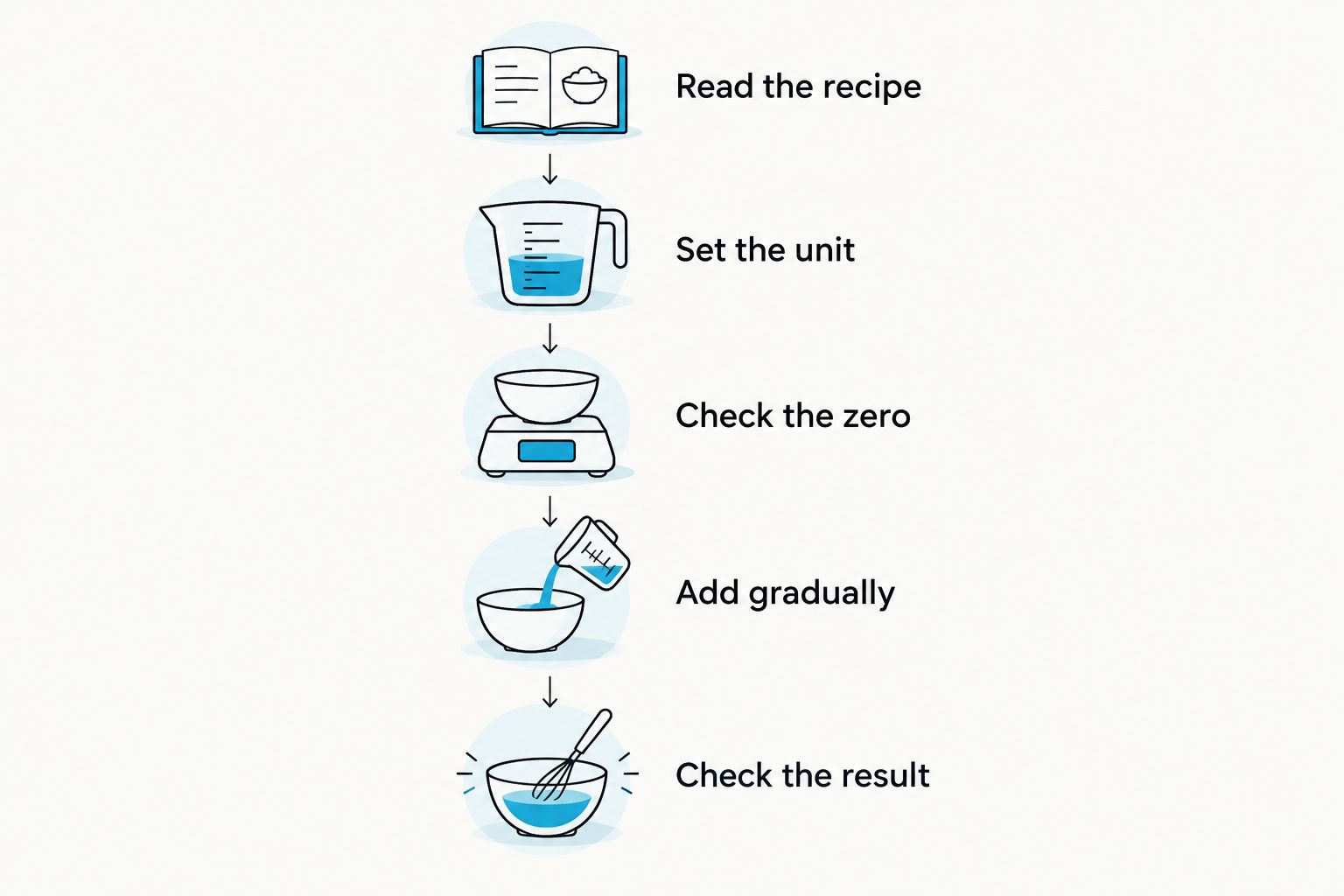
Use this sequence for a recipe written in grams or ounces. Check the tool’s instructions before starting, especially for its weighing method, controls, and permitted load.
- Read the recipe. Identify whether the required measurement is weight or volume. Look for grams, ounces, milliliters, or fluid ounces rather than relying on the ingredient alone.
- Set the unit. Select the matching weight unit when weighing. Do not assume the last setting used is still the right one.
- Check the zero. Follow the instructions for establishing an empty-container reading. If the tool supports tare, use it as directed to exclude the container’s weight.
- Add gradually. Add the ingredient in controlled amounts and allow the reading to settle. Keep your hand from supporting or pressing on the cup while taking a reading.
- Check the result. Confirm both the number and the unit before transferring the ingredient. A correct-looking number in the wrong unit is still the wrong measurement.
When a recipe specifies liquid volume, use the appropriate volume markings or a supported conversion mode according to the instructions. For marked liquid measurements, place the container level and read the liquid at eye level rather than looking down from above.
What does tare actually do?
Tare resets the displayed weight so you can measure what you add next without including an existing load. It changes the starting point of the measurement, not the ingredient’s density or the meaning of the selected unit.
If your tool supports adding ingredients sequentially with tare, follow its instructions. Resetting the display does not remove the weight already inside the container, so the total contents still count toward the tool’s load limit.
What if you add too much?
Remove some of the ingredient and let the reading settle again. Avoid pouring an overmeasured ingredient into the recipe and trying to correct the other ingredients afterward.
For liquids, pouring slowly near the target makes corrections easier. For dry ingredients, adding smaller amounts near the target avoids an unnecessary overshoot.
Does a milliliter setting directly measure volume?
A milliliter label does not, by itself, tell you how the tool obtains that reading. A scale-based liquid mode converts measured weight into estimated volume using an assumed density.
That method is useful only when the assumption matches the ingredient. A mode intended for water is not automatically appropriate for oil or syrup, even though all three pour into the same container.
Before relying on a liquid mode in 2026, check which ingredients the instructions name and how the mode works. Do not infer milk, flour, oil, or other conversion settings from the words digital measuring cup alone.
A conversion setting is an ingredient-specific shortcut, not a replacement for checking the recipe. When the recipe gives grams and the tool supports grams, weigh directly instead of converting through volume.
Can I use a digital measuring cup for flour?
A digital measuring cup can weigh flour when its instructions permit dry ingredients and its supported range fits the recipe. Use the weight unit specified by the recipe rather than treating a filled cup as a fixed weight.
The advantage is avoiding the packing differences that affect scooped volume measurements. The limitation is that the tool still needs suitable capacity, resolution, and handling instructions for your task.
If the recipe provides only cups, follow its stated filling method. Do not invent a gram equivalent from a different recipe, because ingredient type and measuring technique affect the conversion.
Can I measure oil using the water setting?
A water-based volume conversion is not the correct conversion for oil. Oil and water have different densities, so equal weights do not represent equal volumes.
Use volume markings suitable for the recipe or an oil-specific setting explicitly supported by the tool. If the recipe gives the oil quantity by weight, measuring that weight avoids the conversion entirely.
What should you check before buying in 2026?
Choose a digital measuring cup by the tasks it must handle, not by the display alone. Keep this checklist beside the product information when comparing options.
- Units: Confirm that the tool supports the units in your recipes. Ounces and fluid ounces need separate attention.
- Capacity: Check both the container’s volume and the scale’s maximum load. These describe different limits.
- Resolution: Check the smallest displayed weight step. A readable screen does not establish suitability for very small quantities.
- Tare: Confirm whether the tool supports excluding the container or resetting between additions. Follow the stated procedure.
- Cleaning: Check which parts can get wet and whether any components detach. Do not assume a digital tool can be immersed or placed in a dishwasher.
- Handling: Consider whether you want to pour from the weighing container or weigh into a separate bowl. That distinction helps choose between a combined cup and a standalone scale.
When browsing Mystic Leaf Supply Co, apply the same checks you would use for any kitchen measuring tool. A cup-and-scale format offers a useful combination, but the instructions determine which tasks and cleaning methods suit the particular product.
FAQ
Is a digital measuring cup the same as a kitchen scale?
A digital measuring cup combines a container with a weighing function, while a separate kitchen scale provides a weighing surface for compatible containers. Choose according to whether you want to pour from the weighing vessel or use different bowls.
Are grams and milliliters the same?
Grams and milliliters are different units: grams describe mass, while milliliters describe volume. For water, 1 milliliter weighs about 1 gram, but that approximation does not transfer automatically to other ingredients.
Can I measure flour with the milliliter setting?
Do not use a liquid conversion setting to measure flour unless the tool’s instructions explicitly support that ingredient and method. When the recipe supplies grams, weighing the flour directly avoids packing-related volume differences.
Does tare increase a measuring cup’s capacity?
Tare does not increase a measuring cup’s capacity. It resets the displayed starting point, while the ingredients already inside still contribute to the total load.
What should I look for in a digital measuring cup in 2026?
Look for supported units, suitable capacity, stated resolution, clear operating instructions, and cleaning requirements that fit your routine. Confirm ingredient-specific conversion modes rather than assuming they are included.
Can I put a digital measuring cup in the dishwasher?
Use a dishwasher only when the product’s cleaning instructions explicitly permit it for the relevant parts. Do not assume the electronic assembly and the measuring container have the same cleaning requirements.
One last thing
Before replacing a measuring tool in 2026, check whether your recurring problem is actually a unit mismatch. A perfectly readable weight display cannot answer a volume question without the right conversion.
Write the unit beside the quantity before you start cooking. That small habit makes it harder to confuse ounces with fluid ounces—or a water conversion with a measurement suitable for another ingredient.