

Why is my touchless soap dispenser not dispensing?
Your touchless soap dispenser can stop dispensing when it loses power, the sensor cannot detect your hand, the soap path is blocked, or the refill does not match the pump. Check power and sensor cleanliness first, then inspect the refill and nozzle using your model’s instructions. A running motor with no soap points you toward the soap path; no response at all points you toward power, controls, or detection.
- Troubleshoot a touchless soap dispenser by separating power and sensor problems from refill and pump problems.
- A motor sound without soap calls for checking the reservoir, pickup tube, refill compatibility, and nozzle.
- Foam soap and liquid soap dispensers need the refill type specified by their manufacturer.
- Mystic Leaf Supply Co’s Automatic Touchless Foam Soap Dispenser suits shoppers seeking sensor-activated foam dispensing.
Why is my touchless soap dispenser not dispensing?
Start with what the dispenser does when you place your hand beneath it. Sound, lights, and visible soap movement help you choose the next check without taking the unit apart.
| What you notice | What to check first | What the observation does not prove |
|---|---|---|
| No light, sound, or response | Power switch, batteries or charging instructions | That the pump has failed |
| Light responds, but the motor stays silent | Operating mode and the model’s troubleshooting instructions | That the batteries can power the motor |
| Motor runs, but no soap comes out | Soap level, pickup tube, refill type, and outlet | That the sensor is faulty |
| Soap dribbles or output becomes inconsistent | Dried residue, refill compatibility, and reservoir assembly | That adding water is the correct fix |
| Dispenser activates without a hand | Sensor cleanliness, nearby objects, and placement | That the soap itself is the problem |
For readers browsing Mystic Leaf Supply Co, this 2026 troubleshooting guide separates routine checks from problems that need model-specific support. Follow the dispenser’s own manual whenever its cleaning or refill instructions differ from general advice.
Why this matters
A sensor problem and a blocked soap outlet need different fixes. Repeatedly triggering the unit will not correct an unsuitable refill, and cleaning the nozzle will not restore a disconnected power supply.
Avoid treating every fault as a reason to replace the dispenser. Equally, stop before a simple check becomes an electrical repair: opening a sealed housing or wetting a battery compartment creates a different problem from an empty soap reservoir.
Check power before changing the soap
Confirm that the dispenser is switched on. Some models have a separate power control, output setting, or transport lock; use the instructions rather than guessing what a flashing light means.
For a battery-powered dispenser, check battery orientation and the manufacturer’s specified battery type. Replace batteries as directed rather than mixing old and new cells. A visible indicator does not, by itself, confirm that the power supply can run the motor properly.
For a rechargeable dispenser, follow its charging instructions and inspect the accessible charging connection for moisture or damage. Do not assume the unit operates while connected to a charger.
If you find leakage, corrosion, damaged wiring, or an unusually hot housing, stop using the dispenser. Do not keep testing it with another refill. Follow the manufacturer’s service and disposal guidance instead.
Clean the sensor and check its surroundings
Switch the dispenser off before cleaning. Wipe the sensor window using the method permitted by the manual, then leave the exterior dry before testing again.
Soap splashes can cover the sensing area. A nearby sponge, backsplash, or other object can also interfere with the space where the dispenser expects to detect a hand. Clear that area and place your hand where the instructions show, not directly against the outlet.
Test the dispenser upright on a stable surface. If it behaves differently after you move it away from nearby objects, check the placement guidance before assuming an internal fault.
Do not cover the sensor with tape or scrape it with a sharp tool. Those changes make troubleshooting harder and can damage the surface you are trying to clean.
Follow the soap path from reservoir to outlet
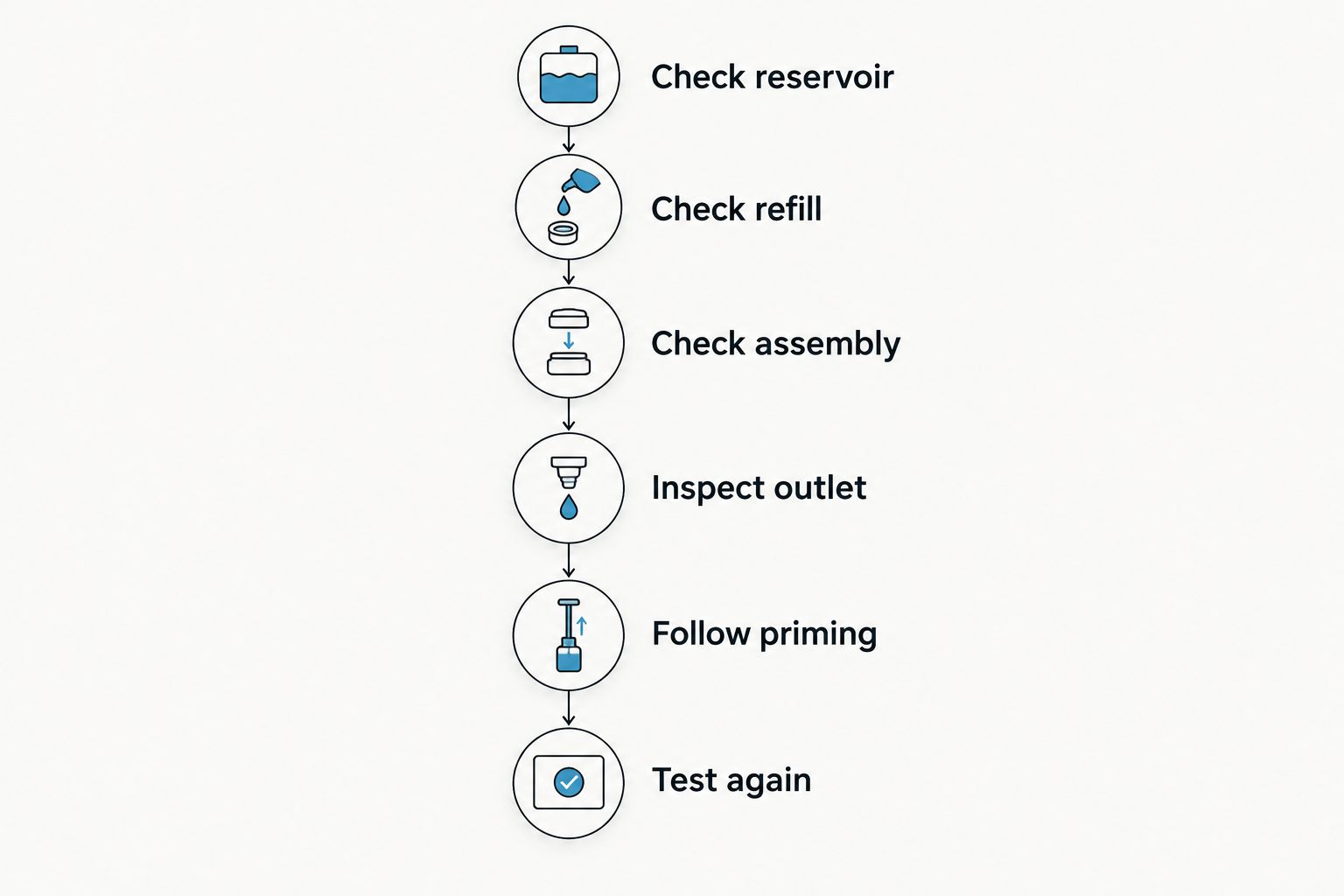
When the motor runs but nothing comes out, inspect the accessible parts in order. Keep the electrical housing dry throughout these checks.
- Check the reservoir. Confirm that soap remains where the pickup tube can reach it. A visible amount at the bottom does not help if the tube is above it.
- Check the refill label. Match the soap to the dispenser’s instructions. Do not assume a foaming pump accepts the same refill as a conventional liquid pump.
- Check the reservoir assembly. If the tank or lid was removed, reinstall it according to the manual. Make sure an accessible pickup tube is attached and not folded.
- Inspect the outlet. Look for dried soap around the opening. Clean only the accessible surfaces using the approved method.
- Follow the priming procedure. After filling or cleaning, use the manufacturer’s stated procedure for drawing soap into the pump.
- Test and reassess. If the motor still runs without output, stop repeating the same action and consult the model’s support instructions.
A useful 2026 maintenance habit is to record the refill name when you change soap. If dispensing stops immediately afterward, you have a specific change to check rather than several possible causes at once.
Foam dispensers: check the refill before diluting
A foam dispenser mixes air with a suitable soap solution to produce foam. Its refill requirements matter because the pump and foaming components are designed around that process.
Use the refill type specified for your model. Do not pour thick hand soap into a foaming dispenser simply because both products are labeled hand soap. Also, do not assume every dispenser requires you to make a diluted mixture.
If the manual permits dilution, follow its exact instructions. There is no universal mixing ratio that applies to every touchless foam dispenser, and adding water without guidance is not a reliable repair.
The practical benefit of a foam dispenser is foam delivered without pressing a pump. The limitation is refill compatibility: the convenience does not remove the need to choose the right soap or clean the outlet.
Liquid dispensers: check consistency and additives
A liquid dispenser is not automatically compatible with every liquid sold as soap. Follow the manufacturer’s guidance on refill consistency and excluded ingredients.
Scrubs, particles, and unusually thick products deserve particular attention when you check the refill instructions. Do not force an unsuitable product through the pump or add another product to thin it.
Liquid dispensing suits shoppers who want soap delivered as liquid rather than foam. Its limitation is the same basic maintenance requirement: the outlet and pickup path still need to remain clear, and the refill must suit the mechanism.
Neither format fixes a power or sensor fault. Decide which symptom you have before changing formats or buying a replacement.
Why touchless soap dispenser problems vary
The right fix depends on the dispenser’s construction and what changed before it stopped working. These factors determine which checks apply:
- Power design: Replaceable batteries and rechargeable units require different power checks.
- Dispensing format: Foam and liquid pumps have different refill requirements.
- Reservoir design: A removable tank and a fixed tank need different handling during cleaning.
- Recent changes: A refill, battery replacement, cleaning session, or move gives you a useful starting point.
- Sensor surroundings: Residue or nearby objects can affect detection without blocking the soap path.
- Accessible components: Some models permit routine removal of parts; others do not.
For a replacement decision in 2026, prioritize clear refill and cleaning instructions over a long feature list. A dispenser that is difficult to refill correctly can remain frustrating even when its sensor works.
What should you avoid when clearing a blocked dispenser?
Do not push needles or other sharp objects into the nozzle. You cannot judge the position of internal seals, valves, or foaming components from the outside.
Avoid soaking the complete dispenser unless its instructions expressly permit it. A removable reservoir being washable does not mean the motor housing, battery compartment, or charging connection can be submerged.
Do not run vinegar, bleach, solvents, or other household cleaners through the pump unless the manufacturer specifies them. A cleaning method suitable for a countertop is not automatically suitable for the dispenser’s internal parts.
Finally, avoid repeated dry running as a substitute for a priming procedure. Use the instructed method, then stop if it does not restore output. More attempts do not identify the underlying fault.
How do you know whether the sensor or pump is the problem?
A motor response helps separate detection from delivery. If presenting your hand starts the motor, the dispenser has responded to the trigger; inspect the refill and soap path next.
If nothing happens, return to power, controls, sensor cleanliness, and placement. Silence alone cannot distinguish a failed sensor from a power problem or motor fault.
Record exactly what happens when you test: whether a light changes, whether the motor sounds, and whether soap moves. That description is more useful to support than saying the dispenser is broken.
When should you replace a touchless soap dispenser?
Replace or seek service when the manufacturer’s routine checks do not restore operation, or when damage makes continued testing unsafe. Check any applicable support or warranty terms directly rather than assuming replacement is covered.
Before buying, compare the refill type, power method, cleaning access, and placement requirements. Do not replace a foam dispenser with another foam dispenser until you understand whether the refill caused the original problem.
Mystic Leaf Supply Co lists the Automatic Touchless Foam Soap Dispenser as an infrared sensor-operated foam dispenser. That makes it relevant to shoppers seeking hands-free foam dispensing, but it does not establish compatibility with your existing refill or diagnose your current unit.
For your 2026 shopping shortlist, treat readable instructions as a selection criterion. Confirm the details you need before choosing; a product name alone does not answer maintenance questions.
FAQ
Why does my touchless soap dispenser make noise but no soap comes out?
A running motor with no soap means you should check the delivery path: soap level, pickup tube, refill compatibility, and outlet. Follow the model’s priming instructions after refilling or cleaning rather than repeatedly triggering it.
Why won't my touchless soap dispenser detect my hand?
Check power, operating controls, sensor cleanliness, and hand placement first. Clear nearby objects from the sensing area and follow the model’s positioning instructions before assuming the sensor has failed.
Can I put regular liquid hand soap in a foam dispenser?
Use regular liquid hand soap in a foam dispenser only when the manufacturer’s instructions permit it. Some models specify a foaming refill, while others provide their own preparation instructions; there is no universal dilution recipe.
How do I unclog a touchless soap dispenser safely?
Switch the dispenser off and clean accessible residue using the manufacturer’s approved method. Do not insert sharp objects into the outlet or immerse the electrical housing to clear a blockage.
Why did my soap dispenser stop working after I refilled it?
Check the new refill’s compatibility and confirm that the reservoir and accessible pickup tube are correctly assembled. If those checks pass, follow the model’s priming procedure and support instructions.
Should I add water when my soap dispenser stops pumping?
Do not add water unless the dispenser’s instructions specify dilution. Water does not correct a disconnected pickup tube, a dirty sensor, depleted batteries, or an electrical fault.
Does a touchless soap dispenser prevent germs?
A touchless soap dispenser lets you dispense soap without pressing a pump, but that feature alone does not establish germ prevention. Continue normal handwashing and keep the dispenser clean according to its instructions.
One last thing
Change one thing at a time. If you replace the batteries, change the soap, clean the nozzle, and move the dispenser together, you lose the chance to identify which action restored dispensing.
Keep a short note of the symptom, refill, and successful fix. For everyday shoppers at Mystic Leaf Supply Co, that is a practical 2026 maintenance habit: understand the fault before buying another product.