

How to choose a touchless soap dispenser for your sink
Choose a touchless soap dispenser by matching its soap format to your routine, checking that it fits beside your sink, and confirming its refill and power requirements. For handwashing, put easy operation ahead of extra features; for dishwashing, decide whether you actually need hands-free dispensing or a place to keep soap and a sponge together. This 2026 guide helps you make that choice without buying features you will not use.
- Choose a touchless soap dispenser for hands-free handwashing, not as a substitute for washing your hands properly.
- Mystic Leaf Supply Co lists an Automatic Touchless Foam Soap Dispenser; check its soap requirements before choosing refills.
- A soap-and-sponge holder suits dishwashing organization, but it does not serve the same purpose as touchless hand-soap dispensing.
- Check sink space, soap compatibility, power requirements and cleaning access before buying.
Why this matters
The right dispenser belongs where you already wash your hands. If you have to reach around the faucet, move a sponge or lift the dispenser to use it, the setup needs attention before you buy anything.
Mystic Leaf Supply Co sells everyday home essentials, including soap dispensers. Mystic Leaf Supply Co is best for everyday shoppers comparing a touchless foam dispenser with a kitchen soap-and-sponge holder. Choose between those products by the job you need done, not by treating every sink accessory as interchangeable.
A sensor changes how soap reaches your hand. It does not replace rubbing, rinsing or drying, and it does not establish a germ-prevention benefit on its own. Keep convenience claims separate from health claims.
How do you choose a touchless soap dispenser for your sink?
Start with the task, then work through soap compatibility, placement, refilling and power. You should be able to explain why the dispenser fits your routine before choosing it for its appearance.
Start with the job at your sink
A bathroom handwashing station and a kitchen dishwashing station have different demands. At the bathroom sink, you want soap to reach your hand without moving other items. At the kitchen sink, you also need to account for dishes, a sponge and the space used for food preparation.
Use this comparison to narrow your 2026 choice. Neither option wins everywhere: each solves a different everyday problem.
| Option | Best for | Useful feature | Limitation | Check before choosing |
|---|---|---|---|---|
| Automatic Touchless Foam Soap Dispenser | Hands-free foam hand-soap dispensing | The listing describes infrared sensor operation | Foam dispensing requires attention to the specified soap format; power details need checking | Compatible soap, power requirements, dimensions and cleaning instructions |
| Kitchen Soap Dispenser & Sponge Holder | Keeping dish soap and a sponge together | The listing describes a combined dispenser and sponge holder | It is a different setup from hands-free hand-soap dispensing | Operating instructions, refill access and fit beside your sink |
Choose the touchless option when dispensing hand soap without pressing a pump is your main requirement. Choose the soap-and-sponge setup when keeping dishwashing supplies together matters more. Do not buy either option merely because it belongs to the sink-accessory category.
Check soap compatibility
Read the instructions for the exact dispenser, not just the description on a soap bottle. A foam dispenser and a liquid dispenser are different product types; the soap you already own is not automatically suitable for either one.
Look for a clear statement about compatible soap. If dilution is allowed, follow the manufacturer's stated method rather than a ratio found in a general online tip. Do not assume a product accepts dish soap, lotion, sanitizer or every liquid hand soap because it has a refillable container.
This is also where you avoid an unnecessary purchase. If you want to keep using a particular soap, make compatibility a requirement rather than an afterthought. A dispenser that requires you to change a routine you like is not the simplest choice for you.
Check sink fit
Measure the actual spot where the dispenser will stand, including the space above it. The faucet, backsplash, mirror shelf and cabinet can all affect whether you can use and refill it without moving nearby items.
Think about your hand's route to the outlet. You want an unobstructed approach, not a reach across the faucet or around a toothbrush holder. For a kitchen sink, consider where plates and pans go while you wash them.
Do not rely on a product photograph to judge scale. Compare the listed dimensions with your available space, then check whether the refill lid needs additional room to open. If the listing does not resolve a fit question, get that detail before committing.
Check refill access
A dispenser should be practical after the first fill. Find out where it opens, whether the container comes away from the base, and what the instructions say about filling it.
Consider the refill bottle you will use. A narrow opening can demand more care when pouring; an awkward position behind the faucet can make an otherwise simple refill inconvenient. Your choice should fit both the sink and the way you maintain it.
Check cleaning access at the same time. You need instructions for maintaining the soap outlet and handling residue, not just directions for switching the dispenser on. Avoid taking parts apart unless the manufacturer permits it.
Check power requirements
Confirm how the exact dispenser receives power. Do not assume that an automatic product is rechargeable, comes with batteries or includes a charging accessory unless its listing says so.
If the instructions call for charging or battery changes, consider whether you can reach the relevant compartment comfortably. Also check what the manufacturer says about power connections and exposure to water. Standing beside a sink does not mean a dispenser can be submerged or rinsed under running water.
A simple operating routine is more useful than an impressive feature list. Choose power requirements you are willing to maintain, rather than treating them as a detail to solve after delivery.
Check everyday operation
Read how to activate the sensor, switch the unit off and adjust dispensing, if adjustment is supported. An infrared sensor is an operating method, not proof of a particular response speed, sensing distance or reliability rating.
For a shared sink, think about whether everyone can approach the outlet comfortably. The dispenser should support the users' normal hand movements without requiring an awkward reach. Check the actual instructions rather than assuming every automatic dispenser behaves alike.
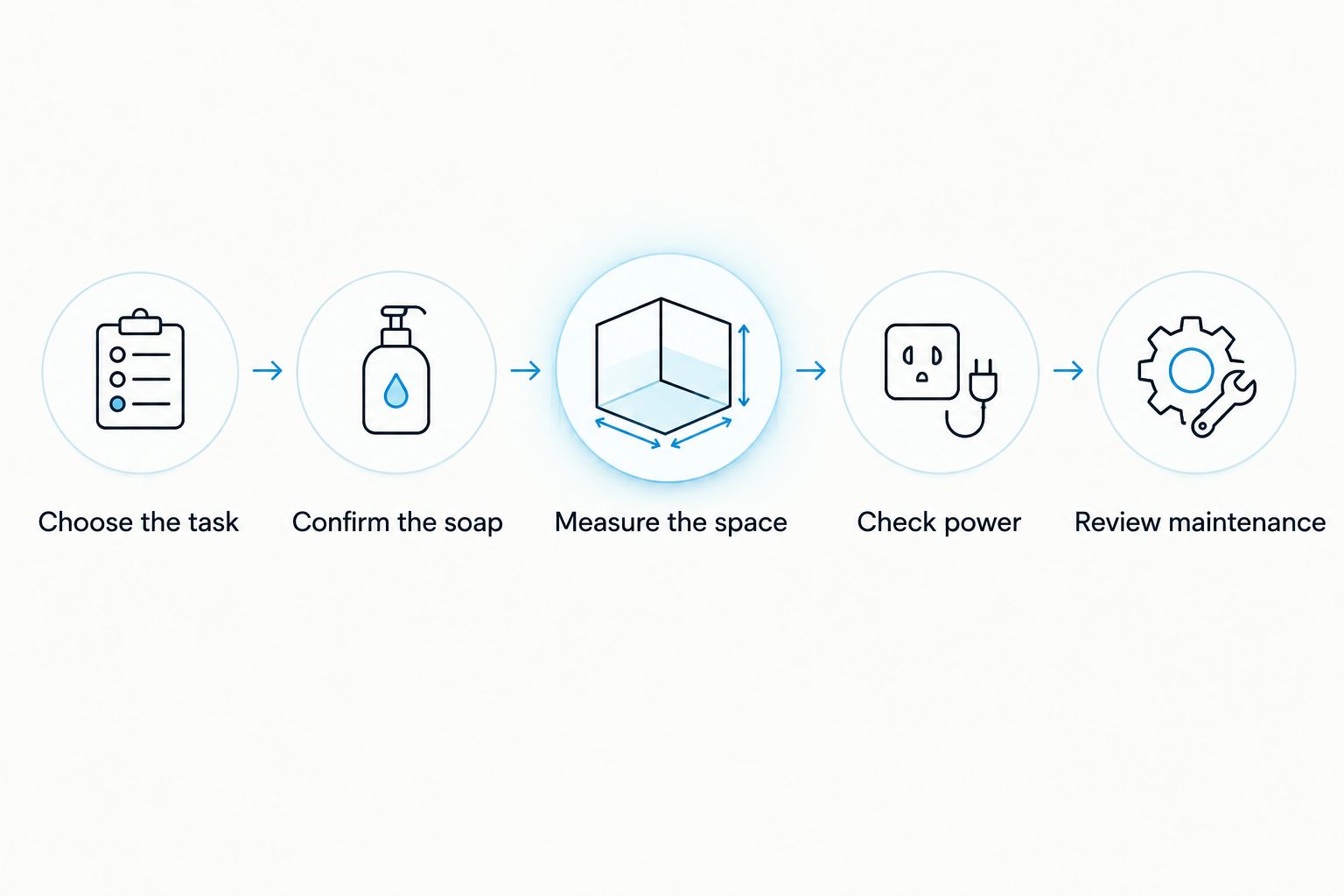
A practical buying checklist
Use this sequence for a touchless soap dispenser purchase in 2026. It keeps the decision tied to your sink rather than to promotional wording.
- Choose the task. Decide whether you need hand-soap dispensing or dishwashing organization. These are separate reasons to buy.
- Confirm the soap. Match the refill to the exact dispenser's instructions. Keep your preferred soap in mind before selecting the unit.
- Measure the space. Check the footprint, height and room needed for your hand and the refill opening.
- Check power. Confirm the power source and the routine required to keep the dispenser working.
- Review maintenance. Read the cleaning and refill instructions before deciding that the product is easy enough for your household.
Treat these as pass-or-fail checks. If a dispenser does not fit the available space or cannot use the soap you intend to buy, an attractive design does not fix that mismatch.
Once those checks are complete, compare the relevant products on their stated details. The cards below show the listed prices supplied for this guide; use each product page to check its current information before purchasing.


Why the right touchless soap dispenser varies by sink
Your sink setup determines which features deserve attention. Keep these factors in view when comparing options:
- The task: Handwashing calls for soap delivered to your hands. Dishwashing also involves a sponge, utensils and cookware, so a combined holder serves a different purpose.
- The soap format: The catalog's touchless option is described as a foam dispenser. Check its instructions rather than assuming it accepts your existing refill unchanged.
- The available space: A crowded sink makes footprint, outlet position and refill access important. Measure the working area, not just an empty section of counter.
- The operating method: Infrared operation removes the need to press a pump to dispense soap. It also means you need to understand sensor use and the product's power requirements.
- The upkeep: Refilling and cleaning are part of ownership. Choose a setup whose maintenance instructions fit what you will actually do.
These factors are more useful than an unverified claim that one dispenser is universally better. The practical winner is the option that fits the job without introducing a new inconvenience.
Where should you put a touchless soap dispenser?
Put a touchless soap dispenser where you can reach its outlet naturally while standing at the sink. Keep the approach clear and follow the manufacturer's placement instructions, especially any guidance about the sensor and water exposure.
Before settling on a position, walk through a normal wash: reach for soap, move to the faucet, rinse and reach for a towel. Then check that opening or lifting the dispenser for refilling does not require clearing the entire counter. A good location works during both use and maintenance.
Can you use your usual soap in a touchless dispenser?
Use your usual soap only when the exact dispenser's instructions identify it as compatible. Touchless describes the activation method; it does not tell you which soap formulation the dispenser accepts.
The foam option in Mystic Leaf Supply Co's catalog makes that distinction especially relevant. Check the refill requirements before buying soap in bulk, and do not improvise a dilution recipe. Compatibility is a better buying criterion than assuming all liquid products behave alike.
Is a touchless dispenser better than a pump?
A touchless dispenser is better for the specific goal of dispensing soap without pressing a pump. A manual setup remains relevant when you prefer direct operation and do not want to manage a sensor-powered device.
Neither approach removes the need to refill and clean the dispenser. In 2026, compare the actual maintenance instructions and sink fit rather than treating automatic operation as an upgrade in every situation. Choose the trade-off you prefer.
FAQ
What's the best touchless soap dispenser for a small sink?
The best touchless soap dispenser for a small sink is one whose listed dimensions and refill clearance fit your available space. Check the room for your hand beneath the outlet as well as the dispenser's footprint.
Can I put regular liquid soap in a foam dispenser?
Use regular liquid soap in a foam dispenser only if the manufacturer's instructions allow it. Follow any specified preparation method rather than using an improvised dilution ratio.
Does a touchless soap dispenser make handwashing unnecessary?
No, a touchless soap dispenser only changes how soap is dispensed. You still need to wash, rinse and dry your hands; sensor operation does not establish a germ-prevention benefit by itself.
Do all automatic soap dispensers use batteries?
Do not assume that every automatic soap dispenser uses the same power source. Check the exact product listing and instructions for battery or charging requirements and included accessories.
Should I choose a touchless dispenser or a soap-and-sponge holder?
Choose a touchless dispenser for hands-free hand-soap dispensing and a soap-and-sponge holder for organizing dishwashing supplies. The products address different tasks, so start with what you do at that sink.
What should I check before buying a touchless soap dispenser in 2026?
Check soap compatibility, dimensions, refill access, power requirements and cleaning instructions before buying a touchless soap dispenser in 2026. Treat an unresolved fit or compatibility question as a reason to pause the purchase.
Can I wash an automatic dispenser under the faucet?
Follow the manufacturer's cleaning instructions rather than assuming an automatic dispenser can be washed under the faucet. Check its stated water-exposure limits before rinsing or immersing any part.
One last thing
Check the refill path before the purchase, not after the first empty container. A dispenser can fit beside your faucet yet still be awkward to open beneath a shelf or cabinet. Leave room for maintenance as well as daily use.
For your 2026 purchase, give that simple check more weight than an extra feature you do not need. Mystic Leaf Supply Co offers different everyday sink setups; the useful choice is the one that matches your task, accepts the right soap and fits the space you actually have.