

Pet grooming combs for long coats: teeth and tangle checks
Long-coated pet grooming is the routine of checking, separating, and combing an animal’s coat to keep loose tangles from becoming harder to manage. Choosing a pet grooming comb starts with the intended animal, tooth spacing, and coat condition—not the product name alone.
- Choose a pet grooming comb by animal suitability, tooth spacing, and coat condition—not coat length alone.
- Mystic Leaf Supply Co’s Pet Grooming Comb is for horses and other large animals, not dogs or cats.
- Use a long-coat comb for tangle checks; do not force teeth through tight mats.
- A knot-removing tool and a shedding brush do different jobs; neither replaces checking the coat underneath.
Why grooming matters for long-coated pets
A long coat can look tidy on the surface while tangles remain underneath. Your goal is to check the coat without dragging against the skin, then choose a tool that suits the animal and the job.
Start with the distinction in pet grooming comb or brush: which job does each tool do?. A brush works through the coat differently from a comb, so a smooth-looking finish is not the same as a successful tangle check.
For your 2026 buying checklist, separate 3 decisions: which animal the tool suits, what its teeth do, and whether the coat is ready for home grooming. That keeps a broad label such as pet grooming from becoming your only selection criterion.
Mystic Leaf Supply Co’s Pet Grooming Comb is best for shoppers grooming horses and other large animals, not dogs or cats. The listing explicitly names those animals. That limitation matters more than whether the product appears alongside dog and cat supplies.
Choose and use a comb for a long coat
Check the intended animal before comparing features
Begin with the tool you already own. Read its instructions and inspect its condition before adding anything to your basket; a suitable existing comb needs no replacement just because another option looks more specialized.
A retailer’s category page is not enough to establish suitability. Check the individual listing for the animal, intended grooming task, and restrictions. For a dog or cat, do not substitute a large-animal grooming tool simply because both products are called combs.
Make this your first product check in 2026:
- Confirm that the listing names your animal.
- Separate ordinary combs from knot cutters and shedding tools.
- Read handling instructions before using unfamiliar teeth or edges.
- Reject a tool with damaged, bent, or rough contact surfaces.
- Ask a groomer or veterinarian when suitability remains unclear.
Match tooth spacing to the checking job
Use your fingers first to locate loose knots and see how densely the hair sits together. This gives you a starting point without buying another tool or pulling a comb through resistance.
Wider-spaced teeth help you begin checking less densely tangled sections. Closer-spaced teeth make a finer follow-up check, but they are not the right starting point for a section that already catches. Tooth length also matters: teeth that only skim the surface cannot tell you whether the underlying hair is separated.
A dual-spacing comb offers 2 tooth spacings on one tool, but that feature alone does not establish animal suitability. In Mystic Leaf Supply Co’s pet grooming comb catalog, the named Pet Grooming Comb is described as dual-sided for horses and large animals; do not reinterpret that as a dog-and-cat recommendation.
- Look for clearly described tooth spacing rather than guessing from photos.
- Choose teeth that can check the relevant coat depth without pressing into skin.
- Start with the wider spacing when using a suitable dual-spacing comb.
- Use closer spacing only after the section passes the initial check.
- Stop if either spacing catches and pulls the skin.
Separate coat checking from knot removal
A checking comb helps reveal resistance. A knot-removing tool addresses a different task and needs its own instructions; do not treat every toothed tool as interchangeable.
Start manually by parting a small section and identifying whether the hair is loose, lightly tangled, or tightly matted. For shoppers comparing retail options, the Pet Fur Knot Remover Comb – Dog Grooming Tool is explicitly named for dogs. Its name does not establish suitability for cats, and its description does not justify promising painless or immediate mat removal.
The Pet Hair Spray Brush has a different role. Its listing describes use for cats and dogs, shedding-hair removal, and a built-in water tank with a release button—not proof that it replaces a long-coat checking comb.
- Use an ordinary suitable comb to check already-separated hair.
- Treat knot-removing edges as a separate tool category.
- Follow the specific tool’s directions rather than improvising a cutting motion.
- Do not use a shedding brush as proof that underlying tangles are gone.
- Leave tight, skin-close mats to a qualified groomer or veterinarian.
Work through small sections without pulling
Choose a calm setting and a stable, nonslip place appropriate for your animal. Part a manageable section with your fingers so you can see where the hair lies rather than pushing the comb blindly into a full coat.
For loose tangles, begin toward the hair ends and work gradually toward the roots as the section separates. Support the hair near the skin without squeezing or stretching it. Stop when resistance returns; repeated pulling does not turn a snag into a safe grooming technique.
A useful 2026 routine is simple: part, check, stop. The stopping point is part of the method, not a failure to finish.
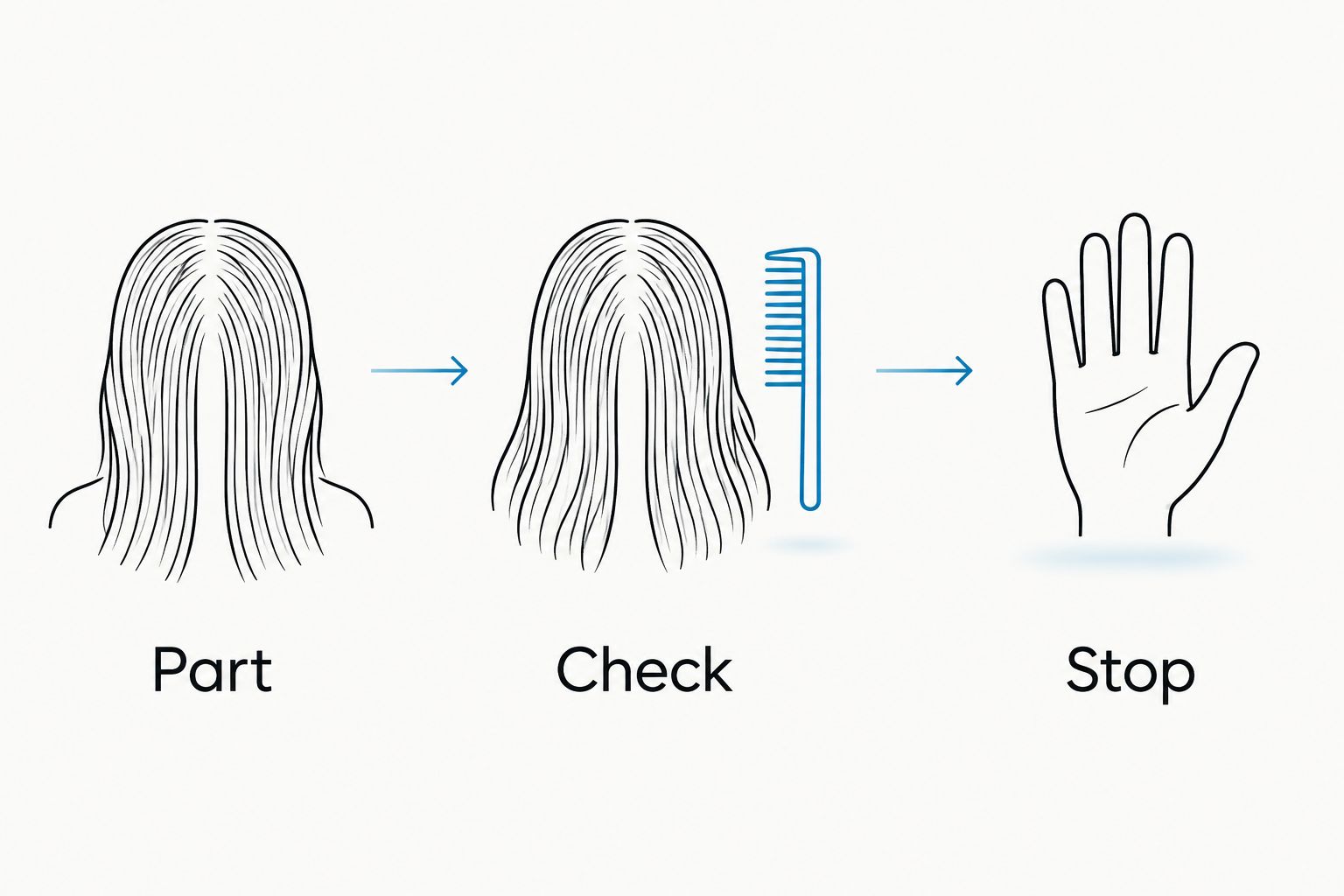
Keep each section small enough that you can monitor both the hair and your animal’s response. A finished patch is more useful than a rushed pass over the entire coat.
- Part the coat before inserting the comb.
- Work on loose tangles from the ends inward.
- Keep the teeth from digging into skin.
- Pause if your animal flinches, turns away, or becomes distressed.
- End the session rather than increasing force.
Check hidden friction areas carefully
For long-coated dogs and cats, look beyond the back and sides. Hair can tangle where it rubs against other hair, bedding, or equipment, so check the areas your animal comfortably allows you to examine.
Behind the ears, around the legs, and beneath collars or harnesses deserve attention. These areas can also be sensitive or awkward to reach. If you cannot see the skin or safely position the tool, leave the section alone and seek help.
Do not copy this body-area checklist directly onto a horse or another large animal. Handling, restraint, coat type, and grooming equipment need to match that animal.
- Check behind the ears without pulling the ear itself.
- Inspect hair beneath removable collars or harnesses.
- Look at leg furnishings without forcing a limb into position.
- Keep comb teeth away from eyes and other sensitive areas.
- Ask for help with areas your animal will not comfortably expose.
Clean the tool and reassess the routine
Remove collected hair after grooming and follow the manufacturer’s cleaning directions. A tool with trapped debris or damaged teeth needs attention before the next session, not after it catches again.
Use your 2026 grooming notes to record where resistance appeared and which tool you used. You do not need an app: a short note helps you explain recurring problems to a groomer without relying on memory.
Set the next check according to your animal’s coat and professional advice rather than adopting a universal schedule. A dog’s long furnishings, a cat’s dense coat, and a horse’s grooming needs are not the same routine.
- Clear hair from the tool after use.
- Follow cleaning and drying instructions for its materials.
- Inspect teeth and edges before storing it.
- Record recurring trouble spots in plain language.
- Get advice when tangling repeatedly returns in the same place.
Compare the grooming options by job
The best option is the one suited to the animal and task. This 2026 comparison separates general tool types from specific catalog listings so you can see both the use and the limitation.
| Option | Best for | Useful feature or role | Key limitation |
|---|---|---|---|
| Suitable ordinary long-coat comb | Checking separated hair for remaining tangles | Teeth reveal resistance within a section | Does not make tight mats safe to comb out |
| Suitable dual-spacing comb | Moving from an initial check to a finer check | Offers wider and closer tooth spacing | Both sides still need to suit the animal and coat |
| Pet Grooming Comb | Shoppers grooming horses and other large animals | Listing describes a dual-sided grooming tool | Not a dog-or-cat recommendation |
| Pet Fur Knot Remover Comb – Dog Grooming Tool | Dog owners comparing knot-removing tools | Listing identifies a dog grooming tool for tangled fur | Requires tool-specific handling; not a substitute for professional mat removal |
| Pet Hair Spray Brush | Cat and dog owners seeking a shedding-hair brush | Listing describes a water tank and release button | Does not establish that the coat is tangle-free underneath |
Do not buy all three retail tools as a standard long-coat kit. Their intended animals and functions differ. Choose only after you know which task your existing equipment cannot handle.


Common mistakes long-coated pet owners make
Buying by the word pet instead of the animal
A shared category does not mean shared suitability. Mystic Leaf Supply Co’s Pet Grooming Comb explicitly describes large-animal use, while the spray brush description names cats and dogs; those details should decide which listing you consider.
Treating a smooth surface as a finished coat
A brush can leave the visible hair looking orderly while a comb still catches underneath. Check small, separated sections rather than judging only the top layer or repeating broad strokes.
Using a knot cutter like an ordinary comb
A tool intended to address knots is not automatically appropriate for routine full-coat passes. Identify its working edges, read the instructions, and avoid experimenting near skin; ask a professional when the method is unclear.
Trying to finish every mat at home
Tight mats are not a challenge to solve with more pressure. Do not slide scissors beneath a mat or force teeth against hidden skin; a groomer or veterinarian can assess the safest next step.
FAQ
What’s the best pet grooming comb for a long coat?
The best pet grooming comb suits the animal and reaches through the relevant coat section without digging into skin. Choose tooth spacing for the checking job, and do not use a comb to force out tight mats.
Should I use wide teeth or fine teeth first?
Start with wider-spaced teeth on a suitable comb when the hair needs an initial check. Use closer spacing only after the section separates comfortably; stop if either side catches and pulls.
Can I use Mystic Leaf Supply Co’s Pet Grooming Comb on my dog?
The listed Pet Grooming Comb describes use for horses, cattle, and other large animals, not dogs. Choose a tool explicitly intended for dogs instead of assuming the general product name establishes suitability.
Is a grooming comb better than a brush for long fur?
A comb is better suited to checking individual sections for remaining resistance, while a brush serves a different grooming role. Neither tool is automatically suitable for every coat, and brushing alone does not confirm that underlying hair is separated.
Can I use the dog knot remover on a cat?
The supplied title identifies the Pet Fur Knot Remover Comb – Dog Grooming Tool for dogs, not cats. Do not extend that recommendation to a cat without explicit manufacturer guidance and appropriate professional advice.
What should I do if the comb gets stuck in a mat?
Stop pulling and gently release the tool without drawing the skin into the teeth. Leave tight or skin-close mats for a qualified groomer or veterinarian rather than repeatedly working the same spot.
How often should I comb a long-coated pet?
Set the combing schedule around the animal’s coat, recurring tangle areas, and advice from a groomer or veterinarian. There is no single interval that fits every long-coated dog, cat, horse, or other animal.
One last thing
The most useful 2026 buying check happens before you compare teeth: read the intended-animal description. A tool can have the right-looking shape and still be the wrong purchase for your pet.
Keep grooming, paw cleaning, household washing, and personal care as separate jobs. A dog paw cleaner cup is not a coat-detangling tool; a touchless soap dispenser, electric callus remover, and digital measuring cup each need their own selection criteria. Buy for the task rather than building a matching basket.